
What To Do Before the Second Wave

There’s a version of this issue I almost wrote.
It had a dramatic opening about the second wave of layoffs. A few data points about headcount math at Series B companies. A killer closer about calendar invites.
You’ve read that issue. I’ve written it nine times with different headlines.
This one is different. This one is just: here’s what I’d actually do, this week, if I were you.

The question nobody is answering honestly
Every piece of career advice right now falls into one of two categories.
The first is doom. Here’s how bad it is. Here’s the data. Here’s the pattern. Good luck.
The second is relentless optimism. Learn AI. Add value. Upskill. Position yourself. It’s full of phrases that mean nothing specific and require nothing specific.
I’ve been guilty of the first. The second makes me want to close the tab.
What’s missing is the middle thing. The honest, specific, slightly uncomfortable answer to: what do I actually do with this information?
That’s what this issue is.
Start with the honest audit
Before any move, you need to know what you’re working with.
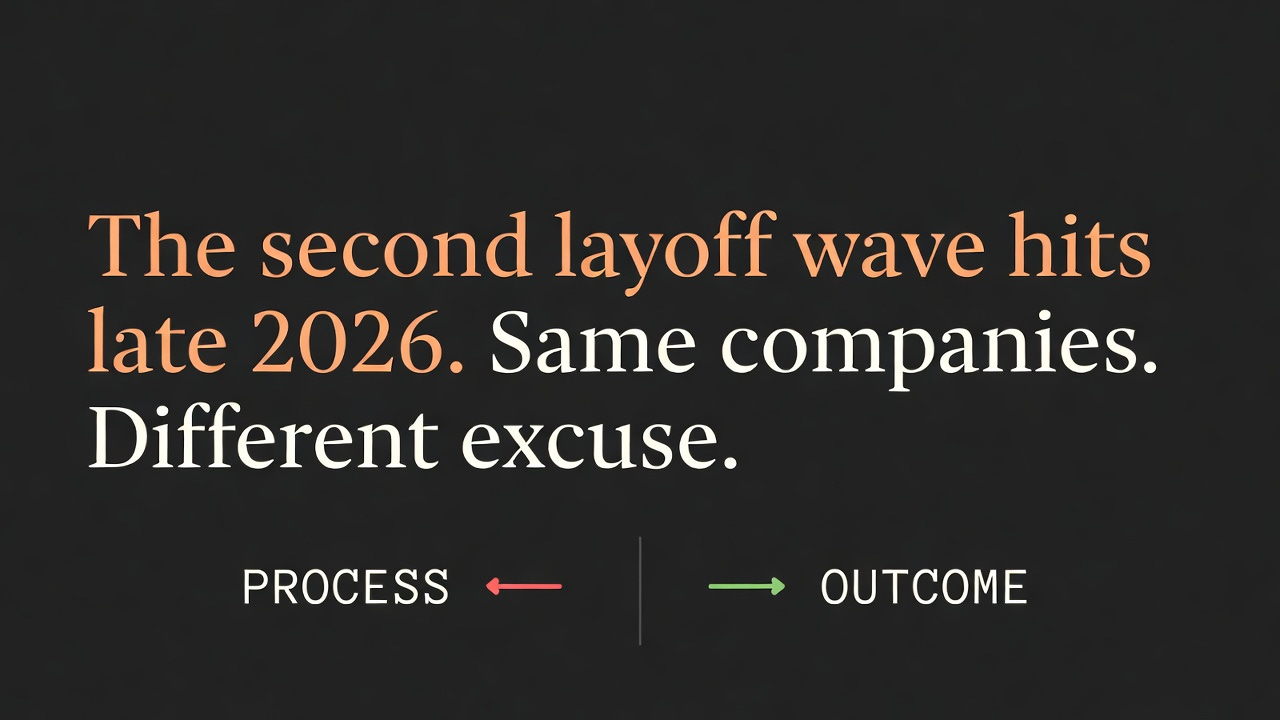
The framework I keep coming back to, and have referenced enough that regular readers will recognize, is the process/outcome split.
Process work is executing known steps to produce a deliverable. Writing the report. Building the model. Drafting the copy. Running the meeting. AI does this. Not perfectly, not always, but well enough and getting better every quarter.
Outcome work is owning a result you’re accountable for when it breaks. When the campaign fails, when the product ships wrong, when the client churns, someone’s name is attached to that. AI assists with outcome work. It doesn’t own it.
Most roles are a mixture. The question is the ratio.
Sit down this week and actually map it. Take your last two weeks of work. List everything you did. Mark each item: process or outcome. Be honest. Don’t round up toward outcome because it feels better.
If you land at 70% process or higher, that’s not a crisis. It’s information. And information is what you make a plan with.
The three moves that actually matter
I’m not going to give you a framework with eight steps. Here are three things. Do them in order.
Move one: Own one result before Q3
Not a workstream. Not a project. A result with your name attached when it breaks.
This is harder than it sounds because most mid-level roles are deliberately structured to distribute accountability. That’s not an accident. It protects the organization and it quietly makes you easier to cut.
Volunteer to own the next thing that has a clear success metric and a clear failure state. The PM who owns the product launch metric is harder to eliminate than the PM who contributed to it.
In the UK, we’ve seen this play out clearly at the wave of fintech restructurings over the last 18 months. The people who survived weren’t always the most technically skilled. They were the ones with a result attached to their name.
Move two: Map your exposure honestly
Go through your role and identify the three tasks you do most often. Then ask: could a reasonably configured AI tool do an adequate version of this in six months?
Not perfect. Adequate.
If the answer is yes for two of the three, that’s where the risk sits. Not because you’ll be replaced tomorrow, but because when headcount pressure arrives, “this function can be partially automated” is exactly the language that shows up in the restructuring memo.
You want to know this before your manager does.
Move three: Find out who actually makes headcount decisions
This sounds obvious. Almost nobody does it.
Your direct manager has less influence over your continued employment than you think. In most companies above 50 people, headcount decisions run through finance, through the CFO’s model, through whoever owns the department P&L.
That person probably doesn’t know your name. They know a number.
This week, figure out who that person is at your company. You don’t need to do anything with that information immediately. But you need to know where the decision actually gets made.
I want to be honest about something.
Writing specific guidance is harder than writing analysis. Analysis lets you be right at the macro level while being vague about the individual. Guidance requires you to commit to something that might not apply to every person reading it.
I almost made Move One more hedged. “Consider owning a result, if that’s appropriate for your role and your organization’s culture.”
That sentence is useless. So I cut it.
Some of this will be wrong for your specific situation. That’s the trade-off. Vague advice that applies to everyone produces nothing. Specific advice that applies to most people and annoys a few is the more useful document.
What this is not
This is not “learn to use AI tools.”
That advice is not wrong exactly. It’s just so incomplete that it functions as wrong. Everyone is learning to use AI tools. The people who survive the second wave won’t be the ones who learned fastest. They’ll be the ones who figured out which part of their job couldn’t be handed off without something actually breaking.
That’s a different skill. Nobody is teaching it because it requires looking at your own role without flattering yourself.
This is also not “network more.” Networking advice in a displacement wave is like being told to make friends on a sinking ship. The relationships that will matter are the ones built on demonstrated judgment and real accountability, not LinkedIn connection requests.
The timeline question
People keep asking me when.
My honest answer: the second wave hits late 2026 into early 2028. The companies most exposed are the ones that announced AI restructuring between 2023 and 2025 without completing the actual deployment. They cut headcount on the promise of AI productivity. When the productivity numbers don’t close, they’ll cut again. Different language. Same math.
That gives you roughly two to three quarters. It’s enough time if you start now. It’s not enough time if you’re still deciding whether to start.
The X thread on this is running live at @MangoAggro —> I’m tracking the prediction publicly. If I’m wrong, I’ll say so there first.
This week
One audit. One result to volunteer for. One conversation to figure out who owns headcount at your company.
That’s it. Not a course. Not a pivot. Three things before Q3.
The ladder got pulled up. That’s real. But the people who build their own footing don’t need it to come back down.
You already know something is coming. The only question is whether you’re the person who did something about it before it arrived.
interesting read!
I appreciate how you cut through vague advice with specific, uncomfortable truths. The focus on owning outcomes and mapping exposure makes this piece stand out.