
The Number Behind Every Layoff Email


Ford rehired the engineers it laid off for AI last year, and called it a staffing update.
No press release. No line anywhere admitting the automated quality system missed defects a person would have caught. Just new job listings, same titles, quieter this time, filed under something that sounds routine.
CBA did roughly the same thing with 40 customer service roles. The AI voice system couldn’t handle actual call volume once real customers started using it instead of the demo script. Nobody at CBA wrote “we were wrong” anywhere a shareholder could see it. The correction happened the way these corrections always happen. Quietly, in a spreadsheet, months after the original announcement got the headline.
I’ve watched a version of this happen to someone I know directly. A former colleague’s team got the AI-cut memo in March. Two of those exact roles reopened by June, different job title, same responsibilities, same desk practically. Nobody circled back to explain the gap. The gap just sat there, unnamed, the way it always does.
IBM did a version of this too, in the opposite direction, which is almost more revealing. Their own HR leadership said out loud this month that the entry-level pipeline dries up if a company stops hiring into it, and announced tripling entry-level hiring as a direct response. That’s a company admitting, in public, that the earlier decision to gut junior roles created a problem two or three years down the line that somebody now has to fix in a hurry.
Three companies, three different functions, one pattern underneath all of them. The decision gets made fast, gets an AI story attached to it because that story is available and plausible, and then gets quietly walked back or patched over once the actual consequences show up. The correction never gets the same audience as the original announcement. It shows up in a hiring update, a staffing note, an HR memo nobody outside the building ever reads.
Here’s what actually moved this year, and it isn’t the thing everyone’s pointing at.
The Number That Actually Moved
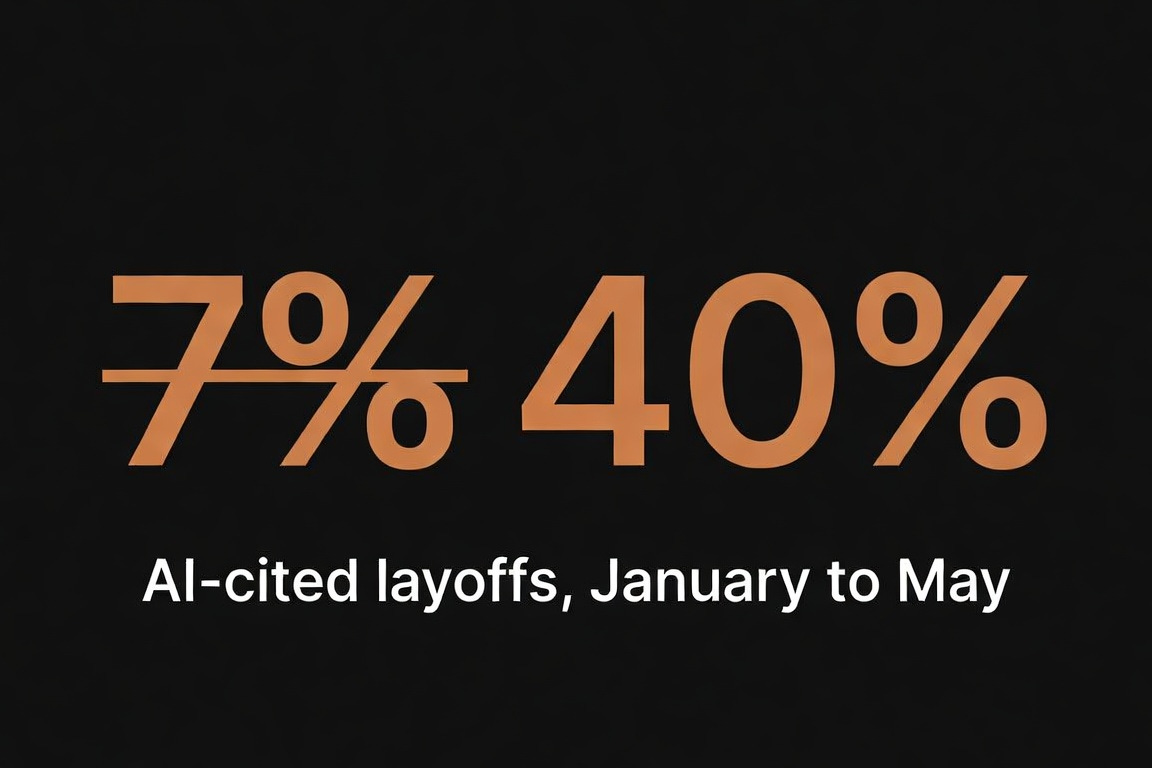
AI was cited as the reason for layoffs in roughly 40 percent of all job cuts announced in May, according to Challenger Gray’s tracking. That’s the third month running where AI has been the single most-cited reason for a workforce reduction. In January, the same category sat at seven percent.
Read that jump out loud. Seven percent to forty percent in four months. Most coverage treated that as proof the technology finally caught up to the hype. I don’t think that’s the actual story, and the reason I don’t think that is a different number that dropped in the same window.
A RAND analysis published this year found frontier-adjacent models coming out of China running at somewhere between a sixth and a quarter of the cost of comparable US systems. Model access got dramatically cheaper across the board this year, not just from one lab, across the entire competitive field.
Here’s the connection nobody in the mainstream coverage bothered to draw. When the underlying tool costs almost nothing to run, citing “AI” as the reason for a cut costs a company almost nothing to claim. Whether or not the automation actually replaced the function cleanly stops being the relevant question. The citation is nearly free. The deployment is a separate, much slower, much messier problem that most companies haven’t actually finished solving.
Ford and CBA are the receipts for exactly that gap. The technology got cited on the way out the door. The technology hadn’t actually finished the job when the door closed.
The Gap Between The Citation And The Reality
The conventional read on the Challenger numbers is straightforward. AI displacement accelerated hard this year, the data proves it, brace for more of the same.
The uncomfortable read, the one I think is closer to what’s actually happening on the ground, is different. A rising AI-citation percentage doesn’t prove AI is displacing workers faster. It proves AI has become the cheapest, lowest-friction line a company can write in a memo, whether or not the actual deployment behind that line is finished, half-finished, or barely started.
That distinction matters enormously if you’re the person losing the job over it. It means the thing supposedly replacing you might not even work yet. It means the excuse arrived faster than the automation did, and you’re the one absorbing the gap between the announcement and the reality.
This isn’t a comforting reframe. I’m not telling you your job is safe because the AI probably can’t actually do it. I’m telling you the reason given for the cut and the actual technical truth underneath it have come apart from each other, and almost nobody currently discussing this wave is distinguishing between the two.
Companies aren’t lying, exactly. They’re doing something closer to using a genuinely real trend as cover for decisions that were mostly about headcount targets and cost efficiency all along. The AI story is true enough, broadly, industry-wide, to make a specific citation plausible in any specific case, whether or not it’s the actual reason in that specific case.
Think about how fast that citation became available to use. Two years ago, “we’re restructuring around AI” wasn’t a sentence most leadership teams could say with a straight face internally, let alone put in an external memo. Now it’s the default explanation, reached for automatically, the way “synergies” used to get reached for during an earlier decade of cuts. The explanation industrialized faster than the technology did. That’s not a conspiracy. It’s just what happens when a plausible story becomes free to tell and nobody’s checking whether it’s actually load-bearing in any individual case.
The people most at risk right now aren’t necessarily in the roles AI is best at automating. They’re in the roles where citing AI is cheapest and least likely to get challenged internally, whether or not the underlying capability is actually there yet. Those are two different maps of exposure, and most people are currently studying the wrong one.
What This Means If You’re Reading This At Work
If your company just cited AI as a factor in a cut, a hiring freeze, or a restructuring announcement, don’t take that citation at face value. It’s not that they’re definitely lying. It’s that the citation tells you almost nothing about whether the actual technical capability behind it exists yet, in your specific function, at your specific company.
Ask a different question instead, quietly, to yourself first. Did the actual output of the eliminated function change, or did the finance decision change? Those are two different problems wearing the same explanation, and they call for two completely different moves on your part.
If the output genuinely changed, if the work is genuinely getting done differently now, that’s a real signal about where the function is headed and you should plan around it honestly.
If the finance decision changed and the AI citation is doing the explaining, that’s a different kind of exposure entirely. It means the actual deployment is still catching up to the announcement, which means there’s a window, not a permanent state, and windows can be used.
A quick version of the audit, for whichever situation you’re actually in. Has your own function’s output visibly changed in the last two quarters, or has the conversation about your function’s budget changed. Did the tool get better, or did the target get smaller. Would the “AI did this” explanation survive someone actually checking the deployment logs, or is it doing the work a much blunter explanation used to do.
None of this means panic less. It means panic more precisely, at the actual thing happening, instead of the version of it that fits neatly into a headline. The generic version of this fear, the one that treats every layoff as proof the robots finally arrived, is easier to sit with in some ways. It’s also less useful, because it tells you to prepare for the wrong threat. The specific version, the one where the citation and the deployment are two different clocks running at two different speeds, tells you exactly where to look and roughly how much time is actually on it.
The citation is cheap. The deployment still isn’t finished. You can tell the difference if you know where to look, and most of the people currently getting cut don’t get told which situation they’re actually in.
If you’ve been sitting with a citation you were never actually shown the evidence for, that’s the same gap a lot of you have been sending me examples of on X lately. Worth a look over there too.