
The Ladder Got Pulled Up

Something happened at graduation ceremonies this year that didn’t make the business press.
Graduates booed.
Not at a politician. Not at a controversial speaker. At the mention of AI. At commencement addresses that told them the future was bright while they already knew their entry-level job offers had quietly evaporated.
They weren’t being dramatic. They were being accurate.
And the people already in the workforce who watched those videos and felt something uncomfortable. That discomfort is worth paying attention to. Because what happened to that graduating class is a preview, not a separate story.

What actually happened to entry level
The entry-level job market for knowledge workers didn’t collapse all at once. It thinned. Over 18 months, the postings got fewer. The application-to-interview ratios got worse. The roles that did exist got more competitive, with more experienced candidates applying down because mid-level was thinning too.
A LinkedIn analysis found entry-level tech job postings dropped over 30% between 2022 and 2025. The roles didn’t disappear from the org chart. They just stopped being filled when they turned over.
Klarna is the cleanest example. They froze hiring, let attrition run, and watched headcount drop from 5,000 to under 3,500 over two years. No layoff announcement. No severance story. Just positions that stopped coming back. The company framed it as AI efficiency. The reality was simpler: they decided not to replace people who left, and AI gave them the language to make that sound like vision rather than cost-cutting.
That pattern of attrition plus hiring freezes, with no headline, is now the standard playbook. It’s cleaner than a mass layoff. No WARN Act exposure. No LinkedIn backlash. No CEO having to explain it on CNBC. The roles just quietly stop existing.
And the people who were supposed to step into those roles never got the chance.
In the UK the picture is sharper than most people realize. Graduate employment in tech roles fell for the second consecutive year. The roles that did open were increasingly demanding experience the candidates couldn’t have, because the internship pipelines had also thinned. A closed loop that nobody designed deliberately but that everyone contributed to, one small hiring decision at a time.
The pipeline problem nobody is calculating
Here’s what isn’t in any earnings call.
Senior engineers exist because someone let them be junior engineers first. Let them ship something slow. Debug something wrong. Own a small failure that was real enough to hurt but not catastrophic enough to end their career. That’s how the instinct gets built. Not through a course. Not through a certification. Through being wrong in front of people, repeatedly, until you develop the judgment that can’t be shortcut.
You cannot skip that process and expect to manufacture senior talent on demand five years later.
The companies that quietly eliminated their junior hiring over the last two years did not eliminate the need for senior talent. They eliminated the pipeline that produces it. The senior engineers those juniors would have become in 2028 and 2029 simply don’t exist yet. They’re not behind. They’re not underqualified. They just never got the entry point that would have started the clock.
I’ve been sitting with this longer than I expected to. There’s something genuinely uncomfortable about watching an entire cohort of people do everything right: the degree, the internships, the portfolio, the networking, only to arrive at the starting line and find the race reorganized while they were training for it. That’s not inefficiency. That’s a broken promise at scale. And the companies that made that promise implicitly, through years of graduate hiring programs and intern pipelines, mostly haven’t acknowledged breaking it.
The knowledge gap that creates is already locked in. You can’t un-do 2023 and 2024 junior hiring decisions in 2026. The compounding that would have happened is gone. The question now is what that means for the people currently in mid-level roles who are going to need that pipeline behind them and find it thinner than expected.
What mid-level should take from this
This is where most coverage of the entry-level story stops. It treats the graduate job market as a problem for graduates. It isn’t. It’s a leading indicator for everyone currently employed.
The logic that made entry-level roles dispensable, that this work can be done more cheaply and reliably by AI, is already being applied to the layer above it. Mid-level roles that are primarily about translating between teams, coordinating timelines, summarizing information upward, and executing defined processes are being evaluated by the same math that made junior roles disappear.
The difference is the timeline. Entry-level went quietly over 18 months. Mid-level will go the same way, slightly slower, because the coordination work is more complex and the relationships take longer to replicate. But the evaluation is already happening in quarterly planning meetings. Headcount reviews. Backfill decisions that keep getting pushed to next quarter.
The companies that cut junior roles didn’t announce a policy change. They just stopped posting when roles turned over. The companies evaluating mid-level right now aren’t announcing it either. The signal isn’t a memo. It’s a backfill request that keeps getting deprioritized. A reorg that leaves your role reporting to someone who can’t quite explain what you do. A skip-level that gets cancelled twice in a row.
Those are the signals. Most people are trained to wait for the explicit signal: the announcement, the meeting invite, the email at 6am. By the time the explicit signal arrives, the decision is already months old.
The process versus outcome audit, applied honestly
Most people reading this believe they sit on the outcome side of the line. The honest audit usually finds something more uncomfortable.
The test is simple but most people avoid running it because they already sense what the answer will be.
For every task in your last two weeks of work, ask one question: if this task had never been done, what would have actually broken in a way someone would notice and care about? Not “would someone have had less context.” Not “would the meeting have been slightly less prepared.” What would have broken. A product. A revenue number. A customer relationship. A system that someone gets paged for at 2am.
If the honest answer is “not much,” that task is process work. And process work is what gets compressed first, regardless of what it says on your job description.
The uncomfortable finding for most mid-level workers who run this audit honestly: more of the list is process than they expected. Summarizing for leadership. Coordinating between teams who could coordinate directly. Translating technical information into formats that AI now generates adequately. Attending meetings to represent a function rather than to change an outcome.
None of that work is worthless. It’s just compressible. And compressible is what the second wave targets.
The entry-level erasure as an opportunity
There’s a version of this story that ends with something actionable rather than just alarming.
The pipeline thinning created a real gap. Organizations that eliminated junior roles now have fewer people building the instincts that come from doing early-career process work: the debugging, the documentation, the small ownership moments that build judgment over time.
That gap is an opportunity for anyone willing to do deliberately what junior engineers used to do by default: own small failures, take accountability for things that could break, build the track record through repetition.
The move this week is specific. Find one thing in your organization that is being handled by a process rather than owned by a person. Something where if it degraded, someone senior would notice. Volunteer to own it. Not manage the process around it. Own the outcome, meaning your name is on it when it breaks at an inconvenient time, and you’re the one who fixes it.
That’s the thing AI can handle the execution of but cannot hold the accountability for. That’s where value is concentrating. Not in the doing of the work. In the ownership of what happens when the work goes wrong.
The window to claim that territory is shorter than most people think. The second wave isn’t coming for people who own outcomes. It’s coming for the layer that sits adjacent to them: the coordinators, the translators, the process managers who are useful but not accountable.
I post this kind of thinking on X in its raw form, before it turns into an argument, sharing the observations before they’re fully formed. If you’re not following there you’re seeing the finished product without the process. @MangoAggro
The entry-level erasure isn’t a story about graduates. It’s a story about what the workforce looks like in three years, who survives it, and how little time there is between now and then to choose which side of that line you’re on.
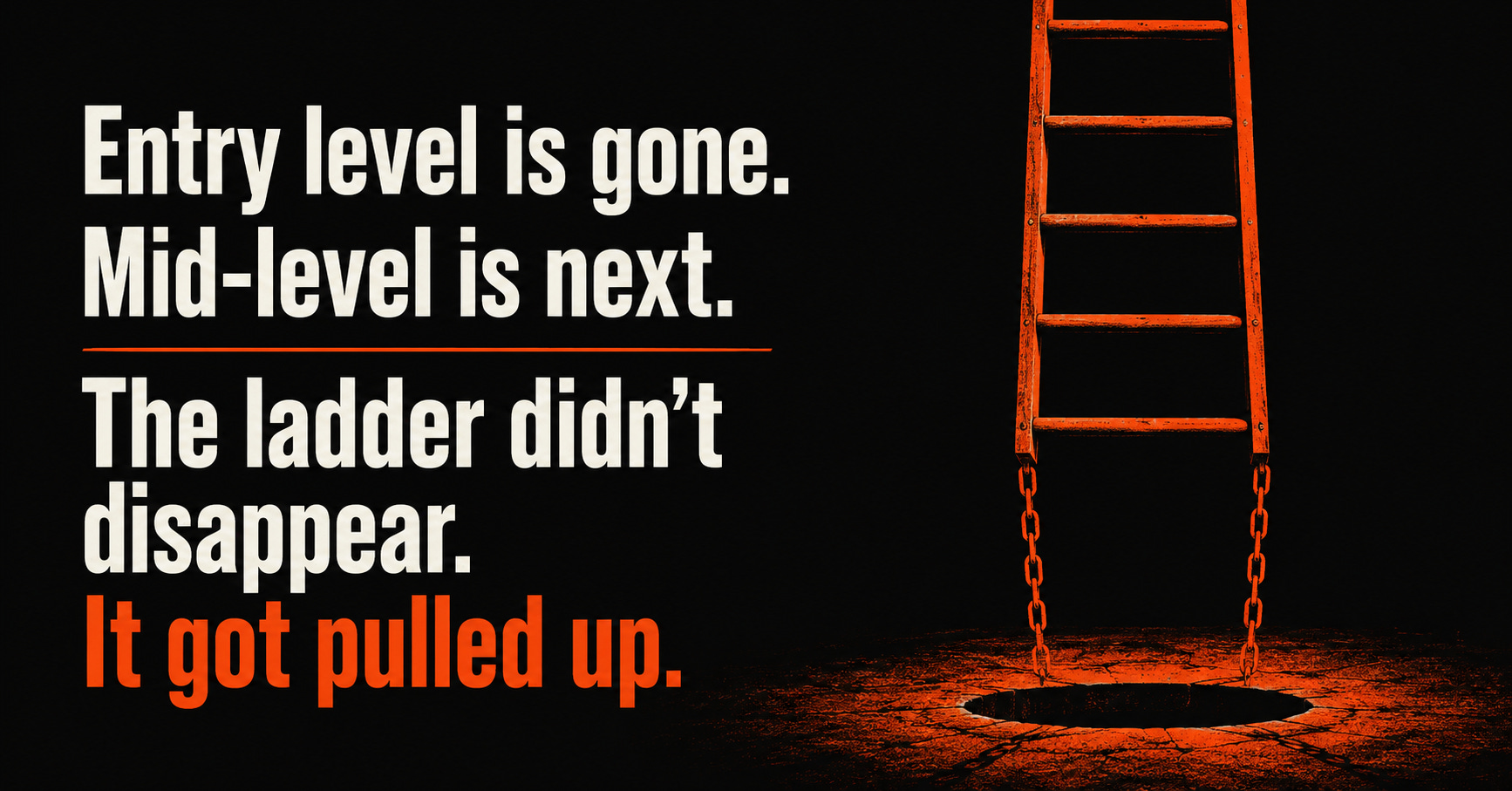
The ladder got pulled up. The people who build their own footing don’t need it.